Decisions you can actually measure.
Antvia Intelligence defines every metric once, answers questions in plain English, and then tells you what your decisions were worth. It runs on Antvia Data, and on the warehouse you already have.
The exact point, answered.
Whichever line brought you here, this is the part of it we are actually claiming, broken down clause by clause.
We pay enterprise BI prices for dashboards nobody trusts.
Antvia is priced on the infrastructure it runs on, not on how many people look at a number. A store manager who reads one report a week is not a licence, which is what stops reporting being rationed to the people who can justify a seat.
Explore lets anyone pick measures and dimensions and get a view, with no SQL and no ticket. Lens carries the ones built by role, so most people open the dashboard for their job rather than building anything at all.
Every metric is defined once, and every surface reads that same definition.Two dashboards cannot disagree, because there is nothing left to disagree about.That is structural, not a governance policy somebody has to enforce.
Trust comes from being able to check. Echo shows the real query it ran and how it read your question, and then Arc and Leap do the thing your current tool cannot: tell you what a decision made against that number was actually worth.
Our product is data-heavy. The platform has to be right first time.
Getting the pipeline right is the part everybody plans for. The part that quietly decides whether it was right first time is whether the business agrees what a number means. Antvia ships that agreement as a layer, not as a wiki page.
Metrics defined after the dashboards exist are metrics negotiated against dashboards that already disagree. Defining them first is cheap; reconciling them afterwards is the eighteen months you were trying to avoid.
We are starting our data and AI journey and do not want to start it twice.
Not just the foundation. Answers on day one: dashboards by role, plain-English questions, and scheduled reports for the people who will never log in. A foundation nobody can query is indistinguishable from no foundation.
Arc and Leap are there from the start and cost you nothing until you use them. When you are ready to record a decision against a metric, there is no migration and no new tool, because they read the definitions you have been using all along.
One definition, everywhere.
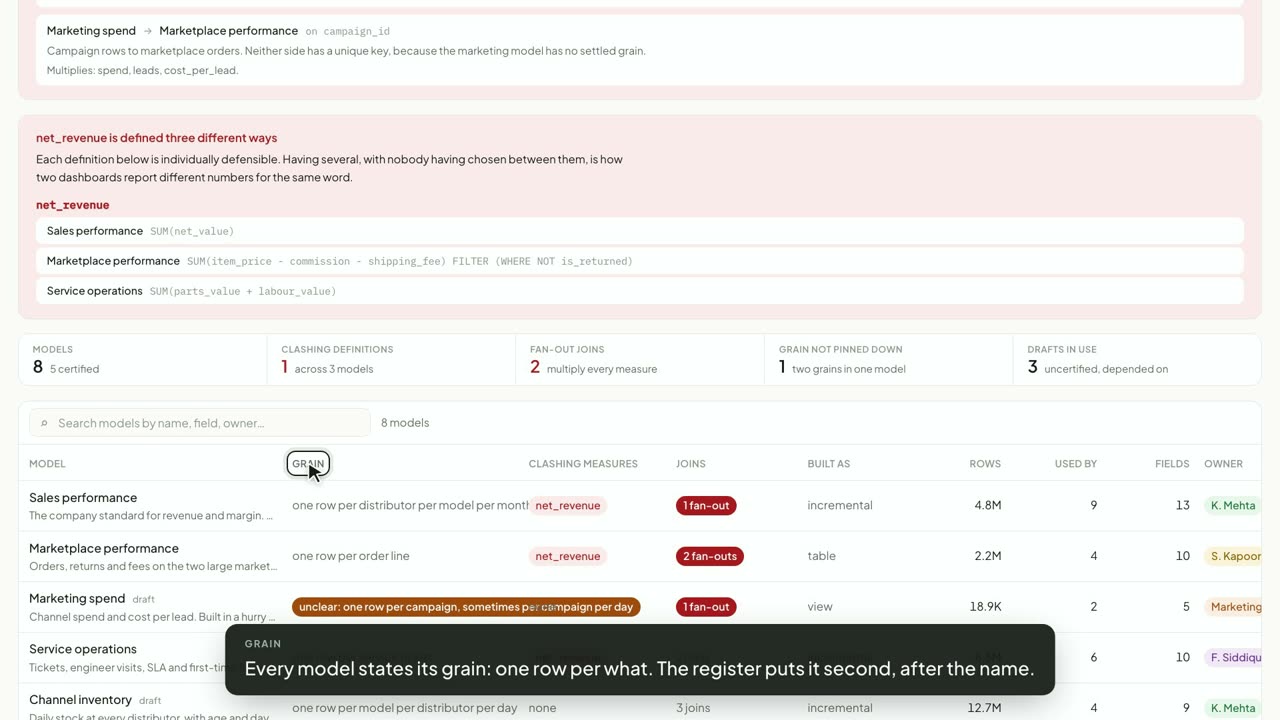 7:26
7:26Gross profit means one thing. It is defined once, in one place, and every dashboard, every question and every decision reads that same definition.
Two dashboards cannot disagree, because there is nothing left for them to disagree about. The monthly meeting where two people bring different numbers stops happening, and it stops happening structurally rather than because somebody was told off.
It is also what makes the rest of this page possible. A decision cannot be measured against a metric that three teams compute three ways.
Three ways to ask, and two ways to be told.
Most people never build anything. The point of the first three is that only one of them is for the person who enjoys building.
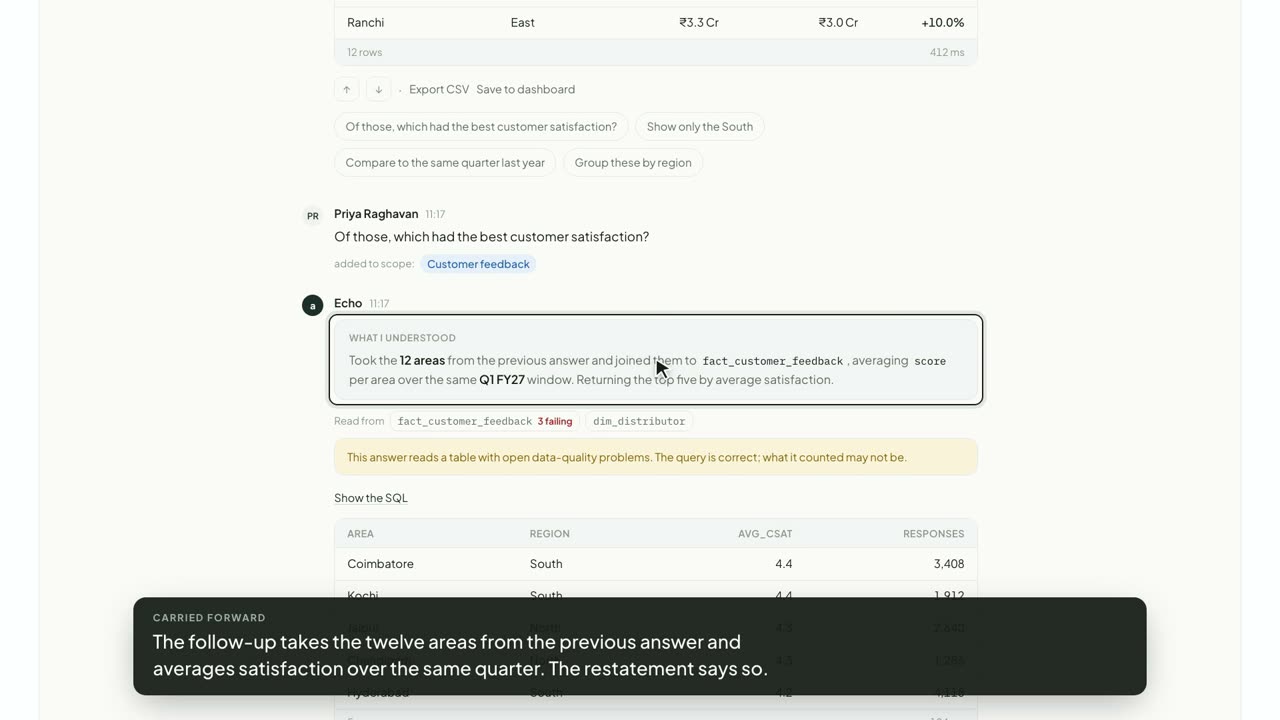 7:24
7:24Lens.
Dashboards pre-built by role. Most people never build anything; they open the one for their job and it is right.
Echo.
Ask in plain English. Echo shows you the real query it ran and how it read your question, so you can check it before you trust it. An assistant that returns only a number is asking to be believed blindly.
Explore.
Pick measures and dimensions and go. No SQL, and no way to construct a wrong number, because the wrong numbers are not expressible.
Reports.
Arrive on a schedule, for the people who will never log in. Most of a business reads its numbers in an inbox, and pretending otherwise is how reporting projects fail.
Alerts.
Arrive because something actually moved. Thresholds, anomalies, rankings and trends, set against the same definitions everything else reads.
This is the part nobody else ships.
A dashboard tells you a number moved. Everything after that, in most companies, happens in a meeting and is never checked again.

It has to name a metric and a scope.
Anyone can write a proposal. It names the metric it expects to move, by how much, by when, and over which stores. If it cannot name both, Antvia will not accept it.
The prediction gets locked.
It is routed for sign-off, and what was expected is locked at the moment of approval. A prediction cannot be quietly revised once the result is in.
The change happens in the business.
Where changes actually happen. Somebody records the date, and that date is what measurement runs from.
Against the prediction, and against the untouched.
Antvia reads the metric against what you predicted, and against the stores the change never reached. It reports the effects nobody predicted alongside the ones you did.
A verdict, not a chart to interpret.
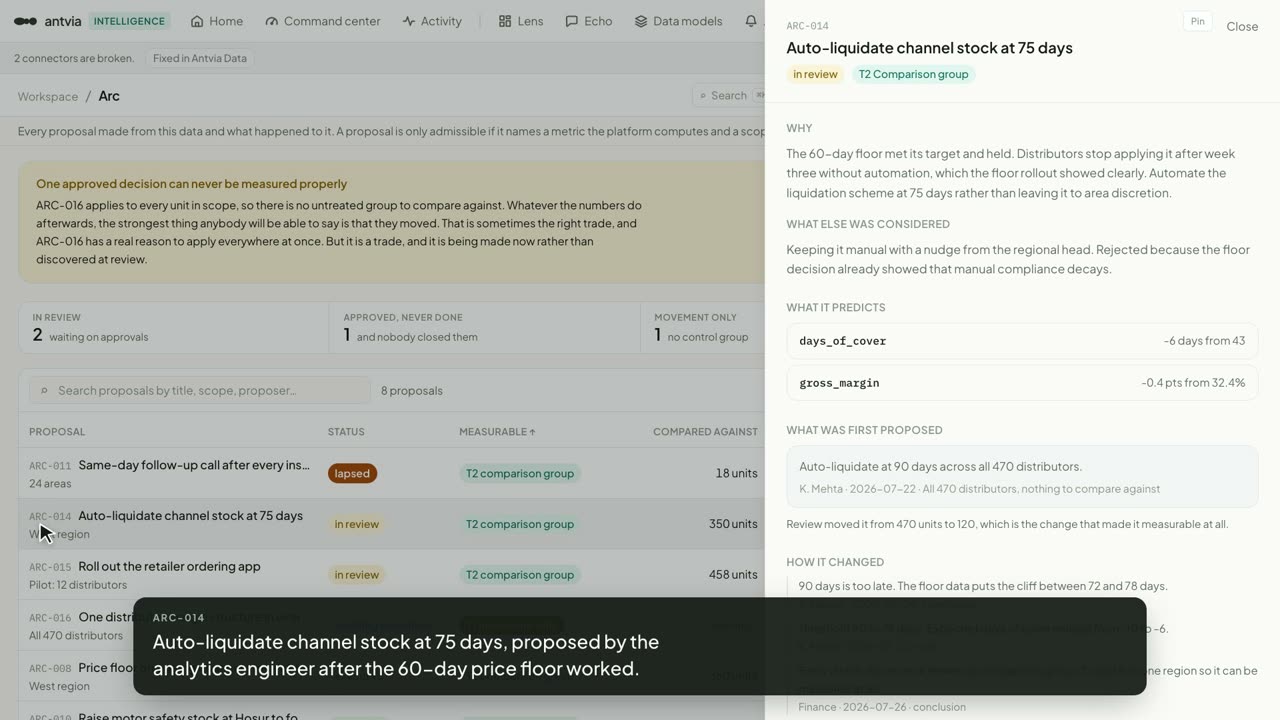 7:36
7:36A price change went live in 40 stores on the third. Nine weeks later, this is what the platform says about it, without anybody having to build a deck.
The gap between what happened and what happened anyway is the only part that belongs to the decision. The stores you never touched are what tells you which is which.
The effect nobody wrote down is reported next to the one they did. A price floor that lifted gross and quietly cost you volume is still worth knowing about.
And it tells you when it cannot tell you.
If another change overlapped the same stores in the same window, the effects cannot be separated. Antvia marks it unmeasurable and leaves it out of the totals. A portfolio that quietly includes results it cannot defend is worth less than one that admits the gap.
Runs on what you have.

Best on Antvia Data.
Your policies are enforced at query time, and it physically cannot see what a user is not allowed to see. Intelligence connects as a system consumer, through the same gate an AI agent uses, with no private back door between the two.
Also on the warehouse you already bought.
Snowflake, Databricks and BigQuery. Same metrics, same decisions, your existing warehouse. Nothing about the decision loop assumes Antvia Data is underneath it.
Eight minutes, from a question to a decision that gets measured.
The tour opens on the command center, asks Echo a question and checks the answer, then follows a decision into Arc and out again through Leap, which reports what the decision was worth.
Recorded in the product, on a demo company rather than a customer. The episode page has the chapters and the whole transcript, and the Antvia Intelligence playlist has the rest of the series. Watch on YouTube.
Three of the five arrive for this half.
Invented companies, used so the measurement argument has something concrete to work on. Each one links to its full profile.
Acme Home Appliances
Channel stock is defined once, so the supply chain view and the leadership view cannot disagree about it.
Read the profile →B2B software, data-heavy productLarkspur Software
Metrics are defined once and then embedded in the product, so the figure a customer sees in the app and the figure the team sees internally come from the same definition.
Read the profile →LendingTollgate Finserv
Portfolio metrics are defined once, so collections, risk and finance read the same number instead of reconciling three.
Read the profile →These five companies are invented. They are the shapes of business Antvia is built for, written out so the product has something concrete to work on, and Acme Home Appliances is the company you will see inside the demo and the videos. None of them are customers.
Bring a decision you made last year.
We will show you what it would look like measured. Bring one you are still arguing about and it works even better.