Your data, governed and ready, in weeks not quarters.
Antvia Data connects every source you already have, cleans it through bronze, silver and gold, and gives your business one version of the truth that people and AI agents can both be trusted to read.
The exact point, answered.
Whichever line brought you here, this is the part of it we are actually claiming, broken down clause by clause.
We have a lakehouse. It is not AI-ready, and it will not survive an audit.
An agent cannot be trusted with data nobody can trace. Bronze, silver and gold give every number a path back to what arrived, and quality gates stop the bad rows before a model or a person ever sees them. Readiness is a property of the pipeline, not a feature you switch on.
Lineage on every hop, a catalog with a named owner per table, and an immutable log of every access change. When the auditor asks who could see what in March, that is a query rather than a reconstruction from memory.
That is usually the part that fails. Antvia onboards an agent the way it onboards a person: named identity, role, namespaces, column masks it cannot see past, and a record of everything it read. No unsupervised connection to the warehouse.
Our product is data-heavy. The platform has to be right first time.
The lakehouse, the governance and the semantic layer arrive asone running system in weeks, not as a programme with three phases and a steering committee. What you get in week four is production, not a pilot.
The operating model ships with it. Owners, freshness states, certification and quality gates are already in place, so the first hire you make is using the platform rather than assembling one.
Open formats, in storage you own, in your own cloud. Leaving is a commercial decision rather than a migration project, which is the only version of right-first-time that survives contact with a change of mind.
We are starting our data and AI journey and do not want to start it twice.
They get rebuilt because the thing that was quick to stand up had no layers, no lineage and no access model, and all three are hard to retrofit.Antvia starts with all three, which is the only part of this that cannot be added later cheaply.
Then leave it switched off. Arc and Leap sit quiet until you want them, and turning them on later needs no migration, because they read the same metric definitions everything else already reads.
Nobody does. What you can control is whether the answer is expensive. Open formats and your own cloud mean the next tool you want to try is a connection, not a negotiation.
Everything you already have, including the spreadsheet.

Databases, files, event streams and APIs. Your dealer management system, your CRM, your ad platforms, the spreadsheet somebody maintains by hand.
Connectors where they exist, uploads where they do not, and a schema designer for the sources nobody has modelled yet.
Nothing gets left out because it was inconvenient. The source that only lives on one laptop is usually the one the argument is about.
Three layers, and the point of them is that you can go back.
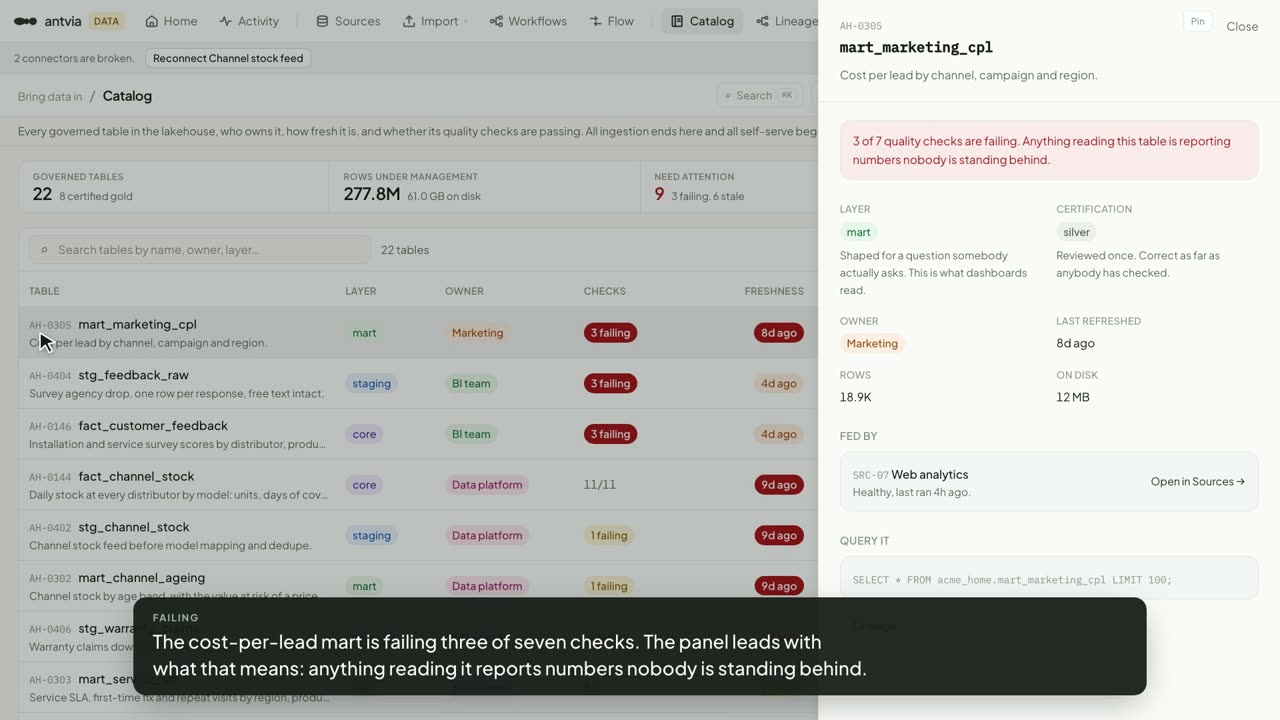
If a number looks wrong, you can walk it back through all three and find out where it went wrong. That is the whole reason to have layers.
 7:39
7:39Governance that is not a slide.
Four things, each of which either happens on every table or does not count.
 7:38
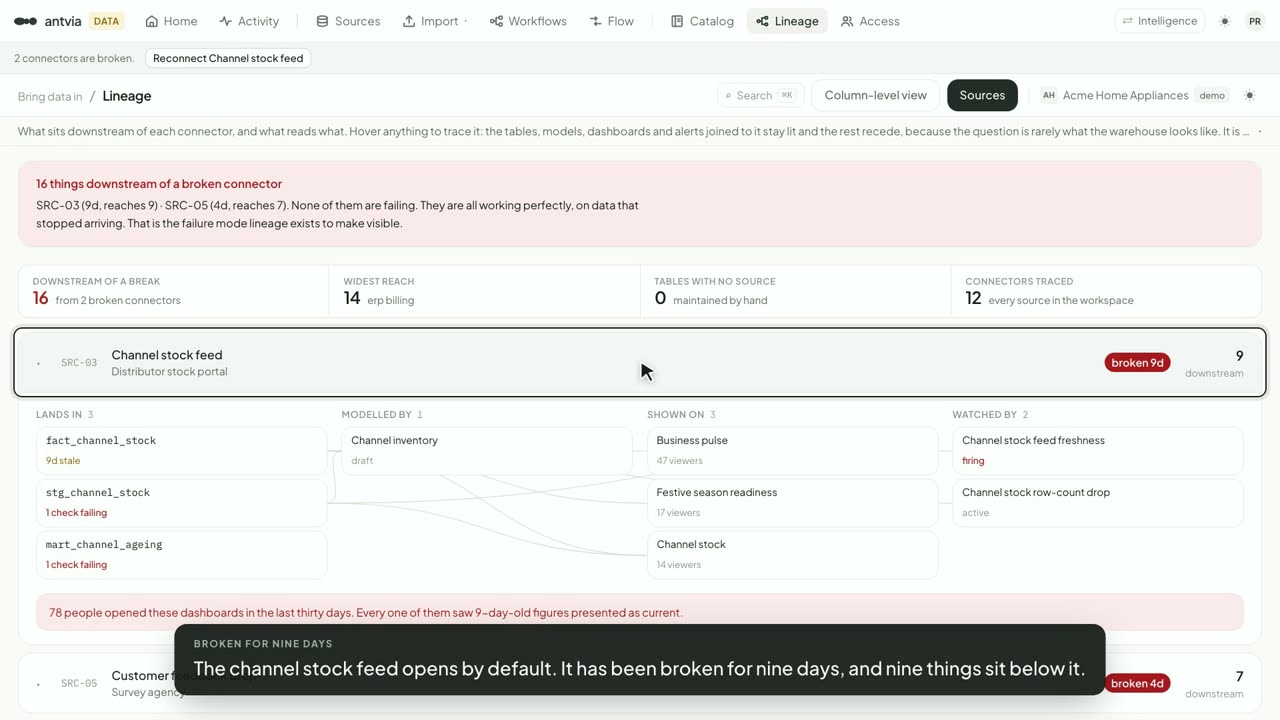
7:38Lineage on every hop.
Every table knows what fed it and what reads it. Nobody has to reconstruct that from memory when something breaks at month end.
Quality gates.
Bad data stops before it reaches a dashboard, rather than after somebody has already presented it.
A catalog with owners.
Every governed table has a name, a description, a freshness state and a person responsible for it.
Certification.
Tables that have earned trust are marked as such. So are the ones that have not, which is the half most catalogs quietly skip.
Every failed AI project fails in the same place. Not the model. The data.
Antvia Data makes data an agent can be trusted with, and then onboards the agent itself the same way it onboards a person: a named identity, a role, a set of namespaces, column masks it cannot see past, and an audit trail of everything it read.
An agent with an unsupervised connection to your warehouse is a compliance incident waiting to be discovered. An agent onboarded through Antvia is a user with a badge.
This is also how Antvia Intelligence connects. There is no private back door between the two products, because a back door is exactly the thing an auditor asks about.
Enforced at query time, not hoped for in a policy document.
 7:24
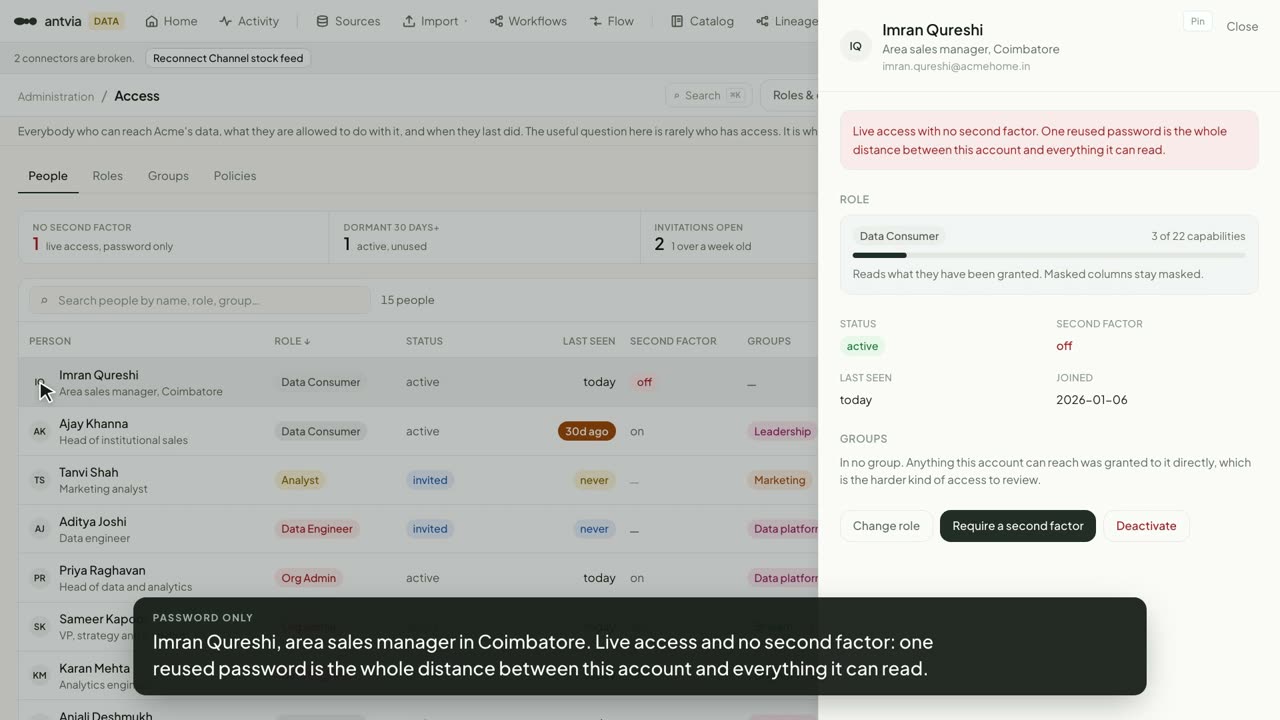
7:24People and systems in one place.
Roles, groups and namespaces for both. One list to review, which is the only kind of list that actually gets reviewed.
Row filters and column masks.
A user who is not allowed to see a column does not see it, because the query never returns it. Not because a dashboard hid it.
An immutable audit log.
Every access change lands in it. When somebody asks who could see what in March, the answer is a query rather than a reconstruction.
Runs in your cloud, in an open format.
Your data stays in storage you own, in a format other tools can read. Leaving is a commercial decision rather than a migration project, and that is deliberate. A platform that has to trap you is telling you something about how it expects to compete.
Nine minutes, from a broken feed to a repaired dashboard.
The tour starts on the home page, where every problem on the platform is ranked, then walks the product in the order data moves. It ends by fixing a broken connector live and watching the repair reach a dashboard.
Recorded in the product, on a demo company rather than a customer. The episode page has the chapters and the whole transcript, and the Antvia Data playlist has the rest of the series. Watch on YouTube.
Four of the five arrive for this half.
Invented companies, used so the governance argument has something concrete to work on. Each one links to its full profile.
Acme Home Appliances
Twelve systems land in one governed lakehouse, cleaned through bronze, silver and gold, with the raw copy kept exactly as the source sent it.
Read the profile →Specialty chemicalsFernhill Specialty Chemicals
Plant systems and lab spreadsheets land as governed sources side by side, with the upload treated as a source that has a schema rather than as an attachment.
Read the profile →Diagnostics and pathologyQuillon Diagnostics
Column masks are enforced at query time, so a person who is not cleared for an identifier does not receive it, rather than seeing a dashboard that hid it.
Read the profile →B2B software, data-heavy productLarkspur Software
One lakehouse with tenant isolation enforced at query time, rather than a separate database per customer and a rule that everyone has to remember.
Read the profile →These five companies are invented. They are the shapes of business Antvia is built for, written out so the product has something concrete to work on, and Acme Home Appliances is the company you will see inside the demo and the videos. None of them are customers.
Bring your messiest source.
The demo works better with a real problem than a clean one. Show us the thing that breaks every month and we will show you where it would land.